


What Does Domain Authority Mean for SEO
Sections
Ever heard the term “Domain Authority” thrown around and wondered what it actually is? In simple terms, Domain Authority (or DA) is a score that predicts how well a website might rank on search engine result pages. It’s a number between 1 and 100, and the higher your score, the better your chances are of ranking at the top.
Think of it as your website’s street cred.
#What Is Domain Authority in Simple Terms?
Let’s use an analogy. Imagine your website is a new coffee shop in a bustling city. When you first open, nobody knows you, so your reputation (your Domain Authority) is low.
But then, a famous food blogger writes a glowing review and links to your website. That’s a huge vote of confidence! Now, imagine a few more well-respected local guides and coffee connoisseurs do the same. Each link from a trusted, popular source builds your shop’s reputation. This is exactly how Domain Authority works - it grows as more authoritative websites link to yours.
This score was originally created by the team at Moz to help marketers understand a site’s ranking strength. It’s built on a logarithmic scale, which just means it’s much harder to grow your score from a 70 to an 80 than it is to go from a 10 to a 20. The climb gets steeper the higher you go.
For a deeper look at this and other common metrics, check out our complete glossary of SEO terms.
Here’s the most important thing to remember: Domain Authority is not a ranking factor used by Google. It’s a third-party metric designed to be a benchmark. Its real power comes from using it to see how you stack up against your direct competitors.
The folks at Moz put it best themselves:

As you can see, the whole point of the score is to predict ranking ability based on link data. It’s a tool for comparison, not a direct line to Google’s algorithm.
#Domain Authority Score Tiers at a Glance
So, what does a “good” Domain Authority score actually look like? It’s all relative to your industry, but this table breaks down the general tiers to give you a better feel for where your site might stand.
| DA Score Range | What It Typically Means | Example Website Type |
|---|---|---|
| **0-20** | New websites or those with a very weak backlink profile. Low search visibility is expected. | A brand-new personal blog |
| **21-40** | A growing site that's starting to build some authority and organic traffic. | A local small business |
| **41-60** | An established website with a solid backlink profile and consistent search engine visibility. | A well-known regional company |
| **61-80** | A highly authoritative site, often a leader in its niche with a very strong link profile. | A national e-commerce store |
| **81-100** | Global authorities and household names with an incredibly powerful and diverse backlink profile. | Wikipedia, Google, The BBC |
Remember, these are just general guidelines. The goal isn’t to hit a specific number but to consistently improve your score and, more importantly, stay ahead of the competition in your specific market.
#How Does Moz Actually Calculate Domain Authority?
Ever wonder what’s going on under the hood when Moz spits out a Domain Authority score? It feels a bit like a magic number, but it’s actually rooted in some pretty serious data. While Moz keeps the exact recipe locked away, we know the single biggest ingredient is your website’s backlink profile.
Everything comes back to links.
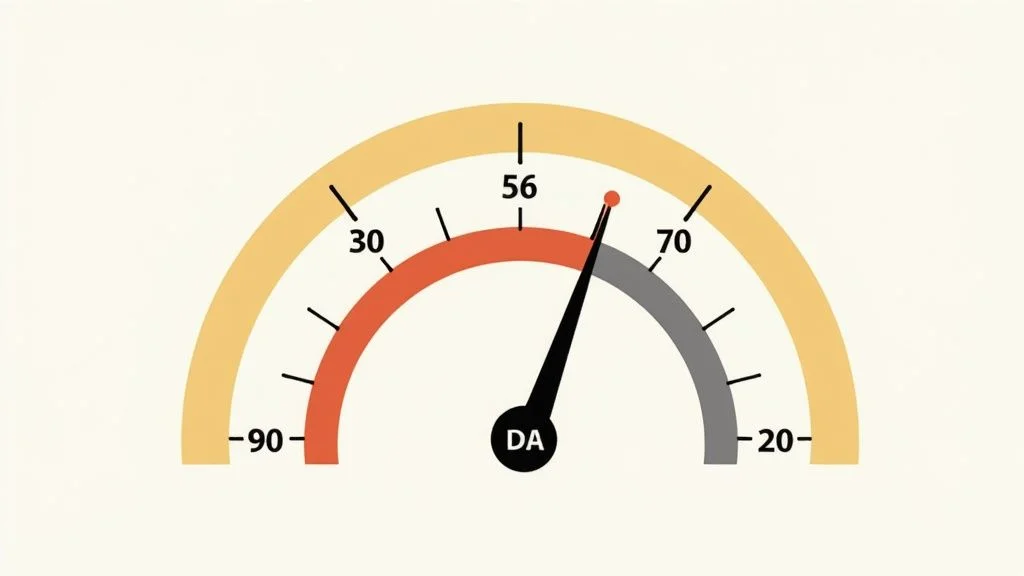
Moz uses a sophisticated machine learning model to come up with the score. They feed it massive amounts of link data and train it to find a “best fit” algorithm that mimics how Google actually ranks websites in real-world search results. The whole point is to create a metric that predicts your site’s ranking potential.
#It’s All About Linking Root Domains
If you take away just one thing, let it be this: the most critical factor is the number of linking root domains. In plain English, that’s how many unique websites are linking to you.
Think of it this way. Getting 100 links from a single website is okay, but getting one link each from 100 different websites? That’s gold. It tells search engines that your site is trusted and valued across a wide spectrum of the internet, not just in one small echo chamber.
Moz’s model crunches data from over 40 different factors, but they all revolve around the quantity and quality of these external links. The two heavy hitters are:
-
The number of unique domains pointing your way.
-
The authority of those linking sites. A link from The New York Times is obviously going to carry a lot more weight than a link from a brand-new, unknown blog.
It’s a classic case of “it’s not just who you know, it’s who they know.”
Ultimately, the calculation is a big-picture assessment. It looks at the total number of links, the overall health of your link profile, and how your site fits into the broader web. Your DA score is really a reflection of your site’s accumulated trust and credibility online.
#Why Your Domain Authority Score Still Matters
Let’s clear the air on a common point of confusion: Google has stated it does not use Domain Authority as a direct ranking factor. So, if the search giant itself doesn’t use it, why should you even bother with it?
The simple answer is that while DA isn’t a direct cause of high rankings, it’s a fantastic predictor of them. Think of it as a quick health check for your website’s overall authority and backlink profile.
A high blood pressure reading doesn’t automatically mean you’re having a heart attack, but it’s a strong warning sign that tells a doctor where to look. In the same way, your DA score gives you a digestible snapshot of your website’s strength and ability to compete in the search results. It’s a proxy metric that effectively models the kinds of signals Google does care about, like the quality and quantity of your backlinks.
#A Powerful Tool for Sizing Up the Competition
One of the best ways to use Domain Authority is for competitive analysis. It’s a brilliant shortcut to understanding the search landscape for the keywords you’re targeting.
Imagine you want to rank for a specific term. A quick check reveals the top-ranking sites all have DA scores of 70 or higher, while yours is sitting at 25. Right away, you know you’re in for a tough fight. That insight is invaluable. It helps you set realistic goals and build a smarter strategy, perhaps by focusing on less competitive long-tail keywords where the playing field is more level.
Key Takeaway: Domain Authority acts as a competitive benchmark. It shows you exactly where you stand in your niche and helps you gauge the effort needed to climb the rankings.
#Smartening Up Your Link Building Strategy
Not all links are created equal, and Domain Authority is your guide to focusing on the ones that count. When you’re looking for guest post opportunities or doing outreach, a site’s DA is one of the first things you should check.
Getting a single backlink from a respected site with a DA of 60 is far more valuable than getting ten links from new sites with a DA of 10. Prioritizing high-DA websites ensures your link-building efforts are efficient, earning you the kind of authoritative endorsements that actually move the needle. This approach is a core part of a well-rounded Search Engine Optimization (SEO) strategy.
#Actionable Steps to Increase Your Domain Authority
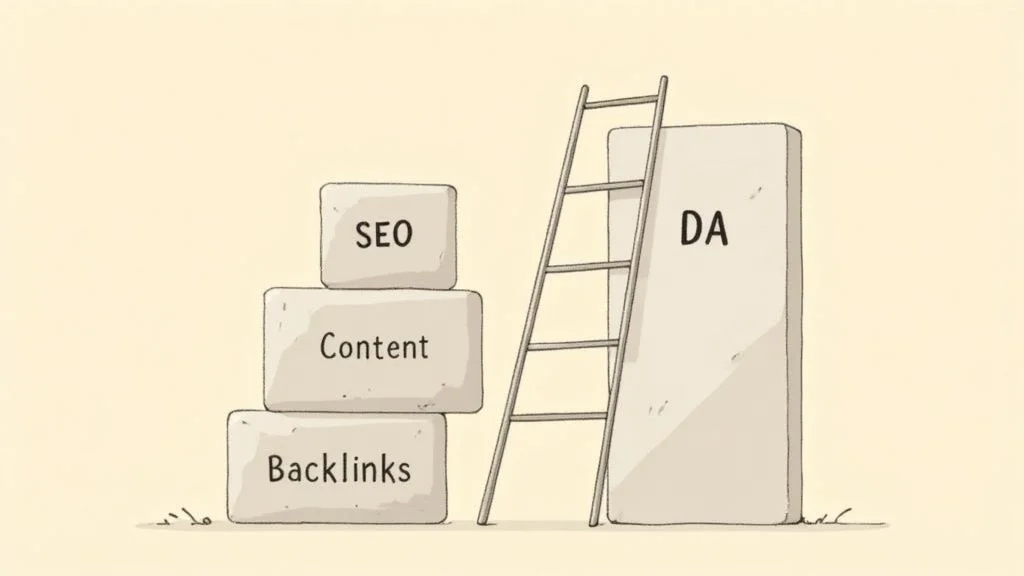
Let’s be clear: boosting your Domain Authority is a long game. It all comes down to one core mission - earning high-quality backlinks from other reputable websites. There are no secret hacks or quick fixes. You build authority by consistently proving your site is a trustworthy and valuable resource.
This journey starts and ends with your content. You need to create things that other people in your industry actually want to link to. Your average, run-of-the-mill blog post just won’t get the job done. The goal is to produce genuinely unique, link-worthy content that stands out.
#Create Content People Want to Link To
Exceptional content is the bedrock of any link-building effort. One of the most effective ways to raise your Domain Authority is to get into a rhythm of publishing top-tier, SEO-optimized content. This means crafting SEO-friendly blog posts that are designed from the ground up to attract both readers and backlinks.
Think about creating content formats that are natural link magnets:
-
Original Research & Data: Are you sitting on unique data? Turn it into an industry report or a survey with compelling statistics. People love to cite fresh data to back up their own points.
-
In-Depth Guides & Tutorials: Aim to create the single best, most comprehensive resource on a given topic. When you become the go-to source, others will naturally reference your guide.
-
Free Tools & Calculators: Build a simple, genuinely useful tool that solves a real problem for your audience. A helpful tool can attract links for years.
When you create assets like these, you give other websites a powerful reason to send their readers your way. Your content does the hard work for you, making your outreach far more successful.
#Master Your Link Building and Auditing
With fantastic content in hand, you can shift your focus to actively building your backlink profile. But it’s not just about earning new links; it’s also about keeping your existing profile clean and healthy. A solid internal linking structure is also vital for spreading authority across your own pages. For a deep dive, check out our guide to building a powerful internal linking strategy.
Your ongoing link-building work should be a blend of these proven tactics:
-
Strategic Guest Blogging: Don’t just write for anyone. Target respected websites in your niche to get your content - and your brand - in front of a new, highly relevant audience while earning a quality backlink.
-
Conduct a Link Audit: At least a few times a year, use an SEO tool to analyze your backlink profile. Hunt down any spammy or “toxic” links that could be dragging your DA down and either disavow them or ask the site owner to remove them.
-
Perform Targeted Outreach: Find journalists, bloggers, and website owners who would find your content valuable. Send them a personalized message explaining exactly why a link to your resource would be a great addition for their audience.
Remember: Building Domain Authority is a marathon, not a sprint. Focus on the slow and steady process of earning one high-quality link at a time. This sustainable approach is what builds real, lasting authority.
#How to Check and Monitor Your Domain Authority

You can’t improve what you don’t measure. That old saying is especially true when it comes to Domain Authority. If you want to build a stronger SEO presence, you need to keep a close eye on your score to see what’s working and where you stand.
Thankfully, checking your score is pretty straightforward. The most direct way is to go straight to the source: Moz’s Link Explorer. Since they invented the metric, their tool is the official benchmark. You just pop in your domain, and it gives you your current DA along with other useful backlink data.
Of course, other major SEO platforms have their own versions. Tools like Ahrefs have “Domain Rating” (DR), and Semrush uses an “Authority Score.” While the names and exact calculations differ, they all aim to measure the same thing - your site’s overall authority.
#Setting Up a Simple Monitoring Routine
When you start tracking, it’s easy to get obsessed and check your score every day. Don’t do it! Domain Authority is a long-term metric, and small daily fluctuations don’t mean much. The key is to watch the trend over time.
Here’s a practical way to stay on top of it without driving yourself crazy:
-
Pick one tool and stick with it. Whether it’s Moz, Ahrefs, or something else, using the same tool gives you consistent data.
-
Get your baseline. Before you do anything else, check your current score and the scores of your top three competitors. This tells you where you are in your niche right now.
-
Check in once a month. At the beginning of each month, jot down your score and your competitors’ scores. This cadence is perfect for spotting meaningful trends and understanding how your efforts are paying off.
This simple routine helps you see the bigger picture. To dig deeper into how your changing authority is actually affecting your rankings and traffic, you can also use our own Search Analytics tool to connect the dots.
#Common Questions About Domain Authority
Once you start wrapping your head around Domain Authority, you’ll probably find a few more specific questions pop up. It’s totally normal. Let’s tackle some of the most common ones to clear up any lingering confusion.
#What Is a Good Domain Authority Score?
This is the big question, but the answer isn’t a single number. Honestly, a good score is simply one that’s higher than your direct competitors. It’s all relative.
Think of it this way: if all the top-ranking sites for your main keywords have a DA between 30 and 40, then getting your site to 45 makes you a real force to be reckoned with. But if you’re trying to break into a market where the big players all have scores over 80, a DA of 45 is just the first step on a much longer journey.
The best way to think about it is to benchmark your site against the websites you’re actually competing against in the search results. Your goal isn’t to hit some magic number; it’s to build enough authority to consistently show up above them.
#How Long Does It Take to Increase Domain Authority?
Patience is key here. Building real authority is a marathon, not a sprint, and you won’t see your score jump overnight. For a brand-new website, it can easily take months - sometimes more than a year - to see a meaningful increase.
Why so long? Because the high-quality, authoritative backlinks that drive your score don’t just appear out of nowhere. They’re earned through consistent, hard work. Instead of chasing quick spikes (which can often signal spammy tactics), focus on steady, sustainable growth. A solid content and link-building strategy is the only proven way to get there.
#Is Domain Authority the Same as Page Authority?
Nope, but they’re definitely related. Both are metrics from Moz, and it helps to think of them as two sides of the same SEO coin.
Here’s the simple breakdown:
-
Domain Authority (DA) measures the ranking strength of your entire website. It’s the big-picture view.
-
Page Authority (PA) measures the ranking strength of a single, individual page on your site.
A site can have a really high overall DA, but each page - your homepage, a blog post, a product page - will have its own separate PA score. That score is heavily influenced by the backlinks pointing directly to that specific page. Looking at both gives you a much richer understanding of where your SEO power really lies.
Ready to track your authority and find actionable SEO insights? Rankdigger provides the tools and guides you need to monitor your progress and outrank the competition. Start analyzing your performance at https://rankdigger.com/en.