


What Are LSI Keywords? A Guide to Semantic SEO
Sections
So, what exactly are LSI keywords? Think of them as the supporting cast in a movie. They aren’t the main star, but they’re essential for telling the whole story.
Let’s say you’re trying to describe a ‘car’ without actually using the word ‘car’. You’d naturally bring up related ideas like its engine, wheels, driving, and the roads it travels on. Those words you’d use to build context? That’s the core idea behind LSI keywords. They are the conceptually related terms that help search engines truly understand what your content is all about.
#Decoding How LSI Keywords Create Context
Imagine a search engine is a student trying to learn a new topic. If you just keep repeating one word over and over - like “java” - the student is bound to get confused. Are we talking about the programming language, the island in Indonesia, or a good cup of coffee? Without any other clues, a single keyword is just plain ambiguous.
This is exactly where LSI keywords save the day. They act as helpful hints that paint a much richer, more detailed picture for search engines. When you include these related terms, you’re not trying to trick an algorithm; you’re simply clarifying your topic and showing you have a deep understanding of it. The real goal is to give a human user the most complete and authoritative answer possible.
If you’re looking to get a better handle on all the lingo, our complete glossary of SEO terms is a fantastic place to start.

#Building a Thematic Map for Google
So how does this actually work behind the scenes? When you publish a piece of content, Google’s bots crawl it, analyzing all the words and figuring out how they relate to each other. The core technology that powers this is called Latent Semantic Indexing (LSI), which surprisingly dates all the way back to a research paper from 1988. It was originally designed to solve the “vocabulary problem” - the fact that different words can mean the same thing, or the same word can have multiple meanings.
By weaving these conceptually linked terms into your writing, you’re helping Google build a clear thematic map of your page.
It’s pretty straightforward in practice:
-
Writing about “java” the programming language? You’ll want to include words like coding, object-oriented, developer, and software.
-
Writing about “java” the coffee? Your content should probably mention things like beans, brewing, espresso, and caffeine.
This layering of context is what really matters. It signals to search engines that your content isn’t just a shallow mention of a keyword. Instead, it shows you’ve created a detailed exploration of the topic, making your page a much more valuable result for someone searching.
#Why Semantic SEO Is a Game Changer

Knowing what LSI keywords are is a great start, but the real magic happens when you see them in action. Using semantically related terms is the difference between simply answering one question and proving you’re an authority on the entire subject. You’re building a rich web of context that Google can’t help but understand.
This has a direct impact on the signals that Google cares about. When your content is truly comprehensive, covering a topic from every angle, people stick around. That increased dwell time and lower bounce rate tells Google one simple thing: this page is a high-quality result that gives searchers what they want.
Instead of obsessing over one keyword, this semantic approach lets your content rank for a whole spectrum of related, long-tail searches you might never have even thought of. At the end of the day, this isn’t about gaming an algorithm. It’s about creating genuinely valuable content that people love - and search engines are built to reward exactly that.
#Elevating Content from Good to Authoritative
Building this semantic richness is how you establish real expertise. When you cover a topic inside and out, you’re well on your way to building topical authority, a massive factor in modern SEO. If you want to go deeper, check out our guide on how to develop topical authority and achieve expert status on Google.
This strategy takes your content way beyond basic keyword matching. It allows you to:
-
Answer Follow-Up Questions: You can anticipate the next logical things a user will ask, keeping them on your page and fully engaged.
-
Capture Wider Traffic: You start ranking for dozens, sometimes hundreds, of related long-tail keywords.
-
Build User Trust: You show that you have a deep, authentic understanding of the subject.
By focusing on the entire conversation around a topic - not just a single keyword - you create content that is resilient, relevant, and far more useful to your audience. This is the foundation of a successful, long-term SEO strategy.
To really get the most out of this, it helps to understand how to effectively integrate AI for marketing strategies that can fuel real growth. A strong semantic SEO plan creates a better user experience, and a better user experience is exactly what Google wants to deliver.
#From LSI to Modern AI Search
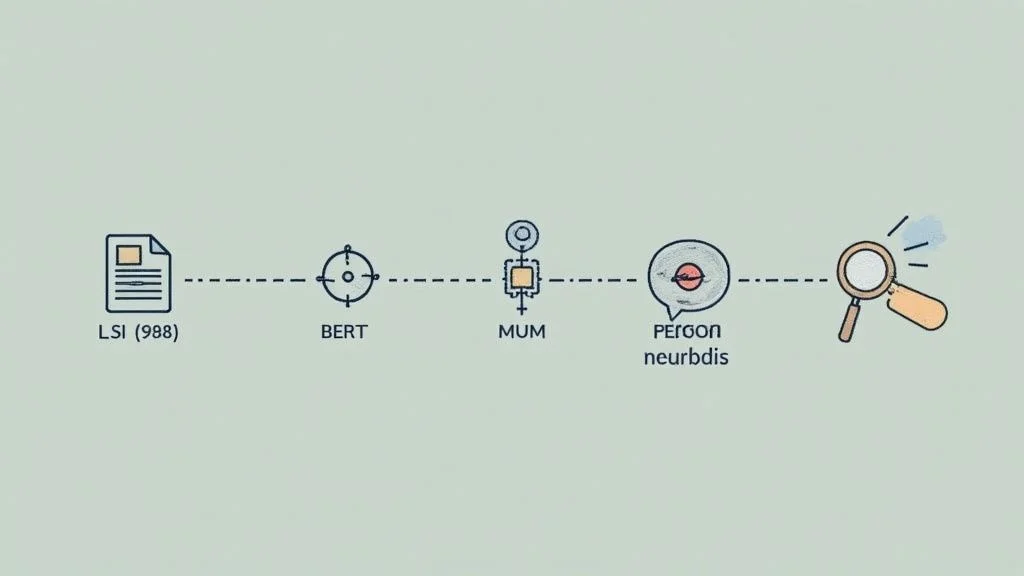
Okay, this is where the conversation gets a little more interesting. Is the term “LSI keywords” even the right one to use today?
Let’s be blunt: technically, no. Google’s technology has rocketed past the original algorithm that was patented way back in 1988. What powers search now is some seriously advanced AI.
Think of the original LSI concept like a horse-drawn carriage. It was a revolutionary way to get from point A to point B. But today’s search engines? They’re more like self-driving electric cars. They’re both designed to get you where you want to go - understanding what a user is looking for - but the technology is worlds apart.
#The Rise of AI and True Semantic Understanding
The real engines driving modern search are systems like BERT (Bidirectional Encoder Representations from Transformers) and MUM (Multitask Unified Model). These AI models do more than just spot related words. They grasp the subtleties of human language - context, sentiment, and the complex relationships between different ideas. They are the supercharged descendants of what LSI first tried to do.
So, why on earth do SEOs still talk about “LSI keywords”? Simple. It’s become a useful, widely understood shorthand for the strategy of using semantically related terms to build context around a topic.
The name might be outdated, but the strategy is more important than ever. The goal is the same: create comprehensive content that completely answers a user’s question and proves you’re an expert on the topic.
By the late 2010s, many experts started pointing this out, arguing that modern search uses far more sophisticated methods. And they’re right. Still, study after study shows that content packed with a diverse range of related terms just performs better. You can read more about this shift over at SurferSEO.com.
Ultimately, the evolution of AI has only made rich, contextual content more critical. Just look at the ongoing conversation about how ChatGPT can help with SEO; it’s a perfect example of how this trend continues to grow.
#How to Find Semantic Keywords for Your Content

Alright, you get the “why” behind semantic keywords. Now for the fun part: the “how.” The good news is that uncovering these context-rich terms is way easier than you’d think. You don’t need a wallet-busting suite of fancy tools to get started.
In fact, some of the absolute best methods are totally free and baked right into the Google search results you look at every day.
These built-in features are a goldmine. Why? Because they’re a direct reflection of what real people are searching for around your core topic. Pay attention, and you’ll walk away with a powerful list of terms to weave into your content, making it leagues more helpful and in tune with what users actually want.
#Mining Google for Semantic Gems
Let’s kick things off with the tools everyone has access to. These manual tricks are perfect for grabbing high-quality ideas straight from the source without spending a dime.
-
Google Autocomplete: It’s as simple as it sounds. Start typing your main keyword into the search bar and watch what pops up. Those predictions are popular, related searches that give you instant clues about what people are curious about.
-
People Also Ask (PAA): This little box is a content strategist’s best friend. It shows you the actual questions users are asking. Each one is a potential subheading or even a whole new section for your article, packed with its own set of related terms.
-
Related Searches: Scroll all the way to the bottom of the results page. That list of “related searches” is a fantastic spot to find long-tail variations and conceptual keywords that can truly enrich your writing.
Think of these Google features as a direct line into the collective mind of your audience. They reveal the language people actually use, helping you move beyond basic keywords to create content that truly resonates.
#Using SEO Tools for Deeper Insights
While poking around Google is a great start, specialized SEO tools can put that process on steroids. When the idea of finding what some call “LSI keywords” blew up in the mid-2000s, it sparked a wave of tools built to speed up this exact kind of research. Tools like LSIGraph, for example, claimed their algorithms could spit out up to 1,000 related keywords from just one search. If you’re curious about the history here, SurferSEO.com has a good breakdown.
To help you figure out what’s right for you, I’ve put together a quick comparison of the different ways you can tackle this.
#Comparing Semantic Keyword Research Methods
This table breaks down the most common tools and techniques for finding semantically related keywords. It’s designed to help you pick the best method based on your budget, how much time you have, and how deep you need to go.
| Method / Tool | Cost | Ease of Use | Best For |
|---|---|---|---|
| **Google SERP Features** | Free | Very Easy | Quick idea generation and understanding user intent. |
| **Google Keyword Planner** | Free | Easy | Finding related terms and checking search volume data. |
| **Dedicated SEO Platforms** | Paid | Moderate | In-depth analysis, competitor research, and large-scale projects. |
Honestly, the sweet spot is blending the free, manual methods with the power of a dedicated tool. You get the authentic, user-driven ideas straight from Google, then back them up with the hard data and scale that a real SEO platform provides. It’s the best of both worlds.
#Weaving LSI Keywords into Your Content Naturally
Alright, so you’ve got a solid list of semantic keywords. That’s a great first step. But the real art is figuring out how to actually use them without sounding like a robot.
The goal isn’t to just cram them in. You want to weave these terms into your writing so smoothly that they make the content better for the reader, not worse. Think of it less like ticking off a checklist and more like adding all the right colors and details to paint a complete picture.
Honestly, your main focus should always be on creating a genuinely helpful, in-depth resource. When you really dive deep into a topic and explain it thoroughly, you’ll find yourself using a ton of related terms and concepts naturally, without even trying. The trick is to be a little more deliberate about where you place them to get the most bang for your buck with both readers and search engines.
#Strategic Placement for Maximum Impact
While there’s no secret formula, some spots in your article just carry more weight than others. Sprinkling your semantic terms in these key areas helps send strong relevance signals to Google and gives your content a much better flow.
Here are a few places to focus your efforts:
-
Subheadings (H2s and H3s): Use related ideas to frame the different sections of your post. If you’re writing about “cold brew coffee,” a subheading like “Choosing the Right Coarse Grounds” is a perfect, natural fit.
-
Body Paragraphs: This is where most of the magic happens. As you explain the process, you’ll naturally talk about things like steep time, using a filter, and making a smooth concentrate.
-
Image Alt Text: Describe what’s in your images with relevant terms. For example, alt text could be: “A glass filter dripping cold brew coffee concentrate into a carafe.”
-
Meta Descriptions: Popping a key related term into your meta description can catch a user’s eye on the search results page and boost your click-through rate.
The best way to use semantic keywords is to stop thinking of them as “keywords.” Instead, treat them as essential subtopics you absolutely need to cover to create the best guide on the internet for your reader.
At the end of the day, just dropping in terms isn’t enough. The real goal is to write engaging content that actually helps people and keeps them reading. The best SEO happens when your content is so valuable that the keywords feel like a normal part of the conversation, not something you forced in to please an algorithm.
#Got Questions About LSI Keywords? We’ve Got Answers.
Alright, let’s clear the air. The term “LSI keywords” gets thrown around a lot, and it’s easy to get tangled up in the jargon. Here are straight answers to the questions we hear most often.
#Are LSI Keywords Just Fancy Synonyms?
This is a super common mix-up, but the answer is a firm no.
Think of it this way: a synonym is a simple swap. “Fast” and “quick” mean the same thing. You can use one in place of the other.
LSI keywords are different. They’re about context, not replacement. For a topic like “gardening,” synonyms might be “horticulture” or “cultivation.” But the related, contextual terms - the LSI keywords - would be things like soil, seeds, watering, and sunlight. They don’t mean “gardening,” but you can’t really talk about gardening without them. They build the bigger picture.
#What’s the Magic Number for LSI Keywords?
Honestly, there isn’t one. Don’t fall into the trap of keyword stuffing. The real goal is to write a genuinely helpful, in-depth article for a human being.
When you truly cover a topic from all angles, you’ll find you naturally use a wide range of these related terms without even trying.
Forget about hitting a specific keyword count. Focus on creating valuable, natural-sounding content. If you’re forcing words where they don’t belong, you’re hurting readability and your SEO.
#Is Google Actually Using LSI Technology?
Here’s the technical truth: No, Google doesn’t use the original Latent Semantic Indexing patent from way back in 1988. Search engine tech has evolved lightyears since then, now running on sophisticated AI like BERT and MUM.
But - and this is the important part - the idea behind LSI is more relevant than ever. The principle of understanding how words and concepts relate to each other to grasp the true meaning of a page is exactly what modern search engines do. “LSI keywords” has simply become the industry’s go-to shorthand for these context-building, semantically related terms that Google’s advanced systems are looking for.
Ready to stop guessing and start ranking? Rankdigger taps directly into your Google Search Console data to uncover high-opportunity keywords and provide actionable insights for your SEO strategy. Take control of your visibility.